

For as long as software developers have shipped software, quality came down to one question asked right before release: “Did we test it?” Green results, sign-off, out the door. Simple, and for a long time, good enough.
It isn’t anymore. Between continuous delivery, AI-generated code, and autonomous agents, that question quietly lost its power. The one that’s replaced it is harder to answer and far more honest: “Can we trust this change?” The discipline that answers it has a name, Continuous Validation, and it’s worth understanding before your release process falls a step behind the pace of change.
Why the question “did we test it?” broke
When one asks, “did we test it?”, that question treats software testing as an event: a phase near the end, with a start, a finish, and a sign-off. It worked when software changed on a schedule you controlled. You could freeze the code, run the suite, and trust that what you validated was what you shipped.
Almost none of that holds up now. Cloud vendors push updates on their own cadence, and AI is increasing the sheer volume of change. Teams release more often, across estates so interconnected that a change which looks contained in one system quietly breaks a process in another. When change is continuous, a validation model built around discrete events is permanently behind.
For years, the hard part of software was building it. The bottleneck moved. Now, increasingly, the hard part is validating it — keeping up with change well enough to know, at any moment, whether the business can trust what’s running.
Testing is an activity; validation is an outcome.
The distinction between testing and validation is that testing is an activity, while validation is an outcome. Testing asks whether a test passed; validation asks whether the company can trust the change and prove it.
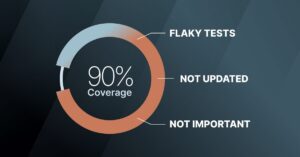
The discrepancy between testing and validation explains a frustration that many quality leaders know well. You can have a plethora of testing activity (test cases, scripts, dashboards, release meetings, for instance) and still not know whether your most important workflows are covered, whether the evidence is trustworthy, or whether the release is genuinely ready. Activity may be high, but confidence isn’t.
Continuous Validation is the discipline of proving, on an ongoing basis, that critical applications, workflows, APIs, and business processes work as intended as change happens.
A few traits set Continuous Validation apart from testing as usual:
- It runs continuously, not at gates. Instead of a slow regression event crammed in before release, validation runs on an ongoing basis — so the question becomes, “what did last night’s run tell us?” rather than “did we have time to test enough?”
- It follows business workflows. Risk lives in processes that span ERP, CRM, finance, and fulfillment — not in a single screen. Validation tracks those end-to-end journeys across system boundaries.
- It produces evidence, not just activity. Every outcome carries proof, such as approvals, audit trails, and traceability. This proof allows a release decision to hold up to internal and external scrutiny.
- It stays deterministic, even with AI in the mix. Across traditional, packaged, no-code, Playwright, and agentic approaches, Continuous Validation aims for repeatable, provable outcomes rather than hoping a model got it right this time.
Making it real
Continuous Validation is a discipline, not a product. At enterprise scale, it needs a platform to fully materialize and become repeatable. This concept lies at the core of Leapwork’s Continuous Validation Platform, and it’s built upon more than a decade’s worth of experience in validating complex, regulated environments.
Enterprise teams that operate in these environments don’t all start in the same place, so they shouldn’t be forced into a single model. This idea is QA Your Way, and it’s the guiding philosophy of the Continuous Validation Platform.
QA Your Way shows up as three complementary capabilities:
- Play, our AI-native enterprise Playwright solution that wraps governance, orchestration, and evidence around Playwright and agentic testing
- Flow, no-code regression testing across web, desktop, ERP, SaaS, and custom apps for the business experts who know the process best
- Go, which provides performance, load, and API testing that proves real-world readiness before production
Most enterprises find a home for more than one of these capabilities. Underneath all three runs a single governed, Deterministic by Design layer: AI for authoring, deterministic logic for execution, a validated boundary between them. Our Deterministic by Design layer ensures every release produces the audit trails and explainable logic that regulated environments require, as a property of the architecture rather than an afterthought.
Strip away the mechanics, and our Continuous Validation Platform provides three essential benefits a business can feel: faster releases with fewer defects, continuous confidence across every system, and governance that holds up to scrutiny.
Asking, “did we test it?” measured effort. Changing the question to, “can we trust this change?” measures confidence — and practicing Continuous Validation is how you keep answering that second question, continuously, as the pace of change keeps climbing.