
Playwright has become the default choice for engineering-led test automation. Playwright is fast, well-documented, maintained, and increasingly the standard execution engine for web-based test automation. However, the same properties that make it appealing to developers, such as code-first authoring and engineer-owned scripts create predictable issues for businesses once a program scales past a single team or a few hundred tests. Enterprises that standardize their testing on Playwright often hit a governance wall as the test suite scales; we’ll discuss what that wall looks like below.
Maintenance and governance: Playwright’s blockers
Running Playwright directly gives engineering teams control and a fast engine. However, every test is authored, read, and maintained in code. This means coverage and maintenance capacity are owned by engineering, with no built-in layer for audit trails, cross-team visibility, or non-technical authorship. As programs scale past a few hundred tests across multiple teams, this becomes a governance and ownership problem as much as a technical one.
Enterprises implementing Playwright encounter two key issues almost simultaneously:
First, ownership concentrates in the hands of a few technical users. Only people who can read and write TypeScript, Python, or Java can create or repair a test. The design of Playwright, and the technical nature of the framework, excludes the QA analysts, business SMEs, and compliance staff who often understand the systems and business logic better than anyone.
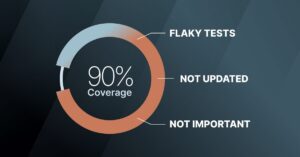
Second, the suite itself becomes unclear and difficult to manage past a few hundred tests. Teams lose visibility into what systems are covered, why a given test exists, and whether a failure is an actual defect or caused by something simple, such as a UI refactor. The same maintenance problem that has always existed in code based test automation is now magnified by the scale and concentrated ownership of Playwright.
The gap here is that Playwright was built to run tests, not to manage, govern, or audit them at enterprise scale. This limited scope excludes non-developers from the project, including risk, compliance, and most importantly the QA teams that understand the enterprise systems and business processes.
How Leapwork extends Playwright instead of replacing it
That governance and authorship layer is what’s missing, and where the Leapwork Continuous Validation Platform excels. Leapwork’s platform works directly in Playwright TypeScript, not our own proprietary format.
Within Leapwork Play, a team can:
- Author tests as native Playwright TypeScript, via recording or natural language, so what’s produced is the same code an engineering team can review and extend.
- Execute at scale, running the suite across enterprise infrastructure without a team having to build its own orchestration layer.
- Self-heal tests automatically when an element changes, allowing QA to repair a native-playwright test without requiring an engineer to intervene.
This is where the Leapwork platform closes Playwright’s gap between non-developers and developers, allowing everyone to write and maintaining Playwright tests. Leapwork’s manual browser recorder and AI Chat let anyone (e.g. SDETs or QA professionals) create runnable Playwright TypeScript inside Play, reauthor, and heal. Leapwork gives business analysts and QA staff a genuine path to contributing Playwright coverage without learning to code, while SDETs get the same test as real, reviewable TypeScript.
The same applies to existing test suites as well. With Leapwork’s knowledge base, a user can import test assets from virtually any tool (incl. Selenium, Cypress) and convert them directly into Playwright. Leapwork’s Knowledge base helps companies become Playwright native, rather than rewriting from the ground-up.
Everything produced in Leapwork Play, whether it’s authored directly, recorded from a live browser session, or converted from an existing suite in another tool, is real Playwright TypeScript that executes at scale, can be reauthored, and self-heals as the application changes. SDETs can review and edit that same code directly; QA analysts and business stakeholders can build and maintain it without writing a line of code.