

A shopper taps “Place Order” on their device. From there, payment, inventory, promotions, and order systems all contribute to what happens next. If one slows down, the shopper may experience a broken next step, even when the storefront itself looks fine. That’s why retail engineering teams need to check both how connected services behave under demand and whether changes still support the customer journey to properly validate APIs and performance.
Validating APIs and performance matters critically during busy periods like Black Friday and Cyber Monday. But traffic spikes are only part of the picture: an Adobe report shows that Cyber Week represented 16.9% of holiday spend in 2024 and 17.2% in 2025. Retail systems and offers change throughout the year, so performance and functional validation need to keep pace with releases, too.
Below, we examine which services to prioritize, how to test them under demand, and how to connect performance evidence with broader release validation.
Which retail services should engineering teams prioritize for API and performance testing?
The services that retail engineering teams should prioritize for API and performance testing are the one most likely to disrupt a critical shopper journey if they fail or slow down. Checkout, payment, inventory, promotions, and order services are good places to start because each can affect whether a shopper completes a purchase and what information they see.
The right priorities depend on your architecture and the release in question. Map the services to the customer-facing steps they support, then consider which changes could affect them. That gives performance testing a clear connection to the release and its risks.
How can retail engineering teams know if checkout and connected APIs will hold up under peak demand?
Retail engineering teams can accurately know if checkout and connected APIs will hold up under peak demand by simulating relevant traffic and monitoring measures such as throughput, latency, and errors. Load testing can reveal bottlenecks or limits before a release reaches shoppers, while functional checks help confirm that the journey behaves as expected. You need both views because a flow can work correctly at low traffic and still struggle as demand rises.
The scenario should reflect the systems and demand patterns relevant to the release. Adobe reported that U.S. consumers spent $13.3 billion online on Cyber Monday 2024, with mobile driving the majority of sales that day. That makes it useful to consider how mobile journeys and the services behind checkout behave during a busy event. (Adobe)
Once teams have a relevant scenario, the next question is how to make those checks part of release work without creating a new bottleneck.
| Leapwork helps retail organizations continuously validate the customer journey across the applications and services behind product discovery, checkout, fulfilment, and every release. See how we do it. |
How can you catch performance regressions without slowing every release?
The key tactic for catching performance regressions without slowing every release is matching the depth of performance testing to the change at hand. An update to an API or checkout service may call for targeted checks; a major platform update or peak-readiness effort may warrant broader scenarios. Repeatable checks can run at relevant points in the delivery process, helping teams spot changes early enough to investigate.
The point is not to run the same large test for every release. It is to make performance evidence available when it can inform a decision. That evidence is more useful when it connects to the functional journey and systems already under test.
How do you connect performance testing with functional validation across retail systems?
Map both types of testing to the same customer journey and its dependencies. A checkout flow may need functional checks across the storefront and payment steps, alongside performance checks for the APIs or services that support them. Together, these results give teams a broader view of release readiness than either view alone.
Different layers may call for different tools and approaches. The key is to understand how each contributes to the journey, then choose validation that fits the systems and release priorities.
How can Leapwork help retail engineering teams validate releases?
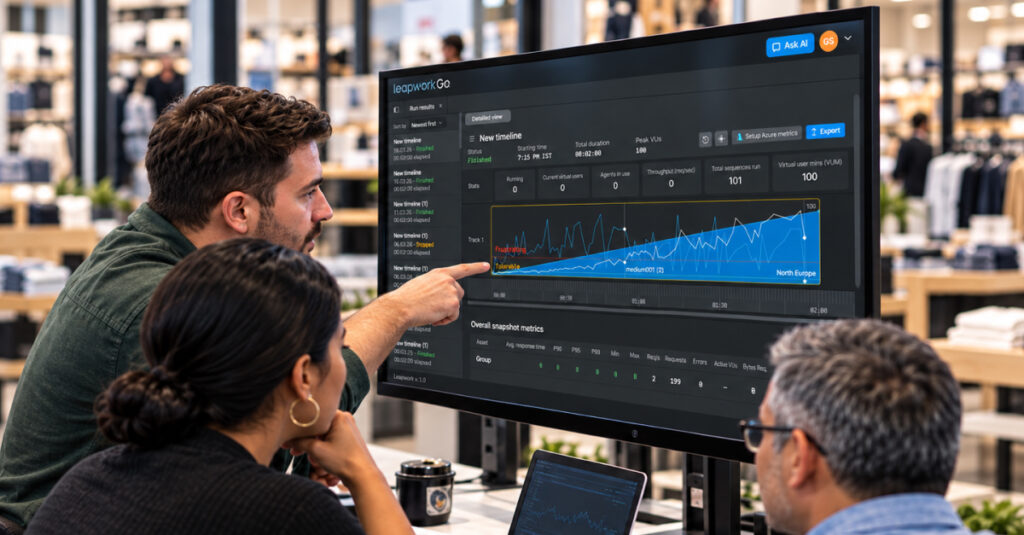
The Leapwork Continuous Validation Platform brings together three solutions that help teams validate different parts of a retail release. Flow handles visual functional and regression testing across connected applications, including web, desktop, and ERP systems. For teams using Playwright to test web experiences, Play adds enterprise governance and reuse around the framework. Go covers HTTP load and API testing, with real-time insight into throughput, latency, errors, and resource usage, and can integrate performance tests into CI/CD workflows such as Azure DevOps, GitHub Actions, and Jenkins.
Together, these solutions give retail engineering teams options for checking that customer journeys work across applications and that the services behind them are ready for demand.