

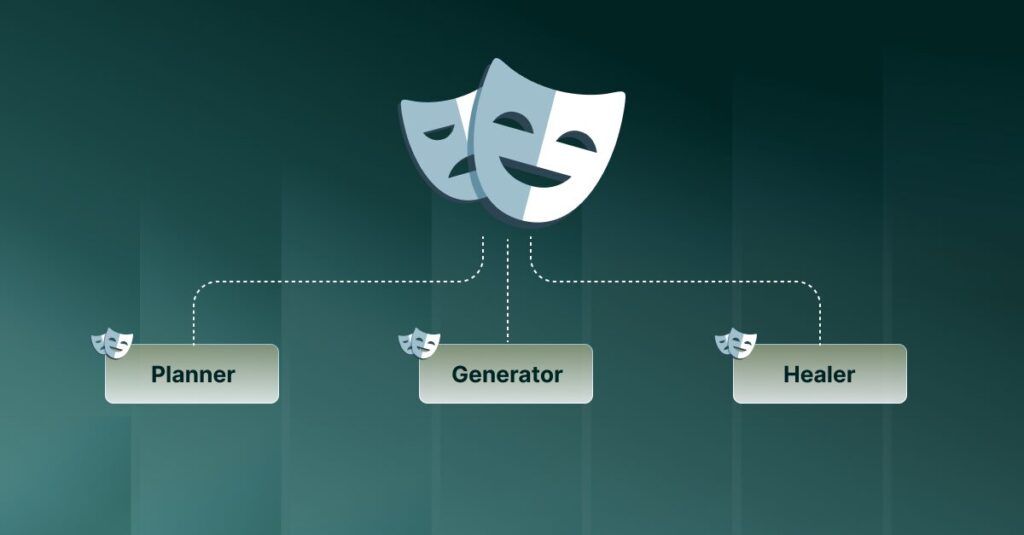
When Microsoft shipped Playwright Agents in October 2025, it raised the bar for what modern test automation could look like. Playwright’s three AI agents (Planner, Generator, and Healer) work together to automate test creation, maintenance, and repair, delivering real speed and reducing manual effort across the entire testing lifecycle. For enterprise teams looking to maximize these capabilities at scale, understanding how to build orchestration and governance layers on top of them is key.
Why These Three Agents?
The last two years of AI tooling have been excellent at producing code quicker. What they haven’t done is make the rest of a release faster. Teams now push more changes per sprint into the same testing capacity they had before, and the gap shows up as regression debt, slipped release dates, and quality steps that get quietly skipped under deadline pressure.
That gap has three distinct chokepoints, and they line up with the three phases of any mature QA practice: planning, authoring, and maintenance.
Planning is where you decide what to test and how the suite should be structured against your application’s real requirements. Done properly, it means combing through documentation, tickets, and existing coverage to work out what actually matters. Done under pressure, it means guessing.
Authoring is where the plan becomes running code. This phase has always gated who can contribute to a suite: if you can’t write TypeScript, you can’t write Playwright tests, however well you understand the product.
Maintenance is where automation efforts tend to die. Tests that passed on Tuesday fail on Thursday because a class name changed, and someone has to work out whether that’s a defect or drift.
Planner, Generator, and Healer address each of those in turn. Individually, each is a capable assistant. Together, they push automation across the full lifecycle instead of a single stage of it.
Planner’s Core Capabilities
Test planning is the phase teams under-invest in most, because it produces nothing runnable. The work is still real: someone must read the requirements, map the flows, and decide what coverage looks like before a single line of test code exists.
The Planner agent explores your application and produces a human-readable markdown test plan. This isn’t just a list of steps; it’s a structured document with scenario overviews, test data matrices, success criteria, and detailed flows. Given a clear request and a seed test that establishes your app’s baseline, Planner discovers UI elements and interactions, then translates them into documented scenarios without manual exploration. For teams drowning in tribal knowledge, this is genuinely valuable; it turns exploration into a reviewable artifact before any code is written.
Generator’s Core Capabilities
A test plan is worth only as much as the suite it produces, and that conversion has always depended on someone who can code. Generator targets that constraint directly, widening who on a team can turn a defined scenario into a working test.
The Generator agent takes Planner’s Markdown and converts it into executable Playwright test code. It identifies selectors, writes assertions, and produces TypeScript test files. This agent’s key skill is that it validates selectors and assertions live as it executes scenarios; it’s not just templating. Generator also respects your codebase’s conventions by mirroring seed test structure and fixtures. In a real-world example from an SDET, Generator turned a detailed checkout scenario into working tests in seconds, complete with price verification and multi-step assertions.
Healer’s Core Capabilities
Every suite accumulates failures that have nothing to do with product defects. Triaging them is unglamorous, constant work, and it’s the reason so many automation programs stall a year or two in.
When tests break, the Healer agent reruns the failing test, inspects the trace and DOM snapshot, and suggests patches. In the SDET’s checkout example, a test failed because a selector matched two elements instead of one. Healer identified the ambiguity and proposed using a more specific CSS locator to resolve it. It then replayed and confirmed the fix. This is the closest Playwright’s agents come to true self-healing; they can fix locator drift and minor assertion issues without human involvement.
Agents as Force Multipliers for Your Team
Playwright’s approach is fundamentally human-centered:
- The Planner cuts exploration time from hours to minutes.
- The Generator turns plans into code faster than handwriting does.
- The Healer patches common failures automatically.
These are genuine productivity gains that let your team focus on strategy and risk assessment rather than manual scripting and maintenance.
The agents follow the Model Context Protocol and execute safely; they’re a structured, auditable acceleration layer designed to augment human expertise, not replace it. This human-in-the-loop approach has always been core to how smart teams use AI in testing: leverage the speed where it shines, keep human judgment where it matters most.
Extending Playwright Agents at Enterprise Scale
Playwright itself is powerful, and its agents deliver tremendous value for teams of all sizes. But agents simply existing and being ready to use does not equate to a production-grade QA strategy.
A production-grade QA strategy needs to have both the code and the agents managed in a repeatable fashion so that when a code push hits your QA pipeline, you can release it with confidence.
This dependency grows even stronger at the enterprise level. For enterprises managing complex test suites across multiple teams, geographies, and compliance requirements, a platform strategy for Playwright that builds on its agents’ capabilities becomes essential. Orchestrating hundreds of tests across nodes, scheduling tests, managing user permissions, maintaining audit trails, and handling multi-environment validation are critical capabilities for enterprises, and they fall outside what test automation frameworks automate.
Leapwork Play extends Playwright agents with governance, evidence, and orchestration that turn Playwright automation into release confidence. Play’s Deterministic by Design approach complements Playwright agents: AI generates the test blueprints using agent capabilities, but what actually runs is a validated, deterministic sequence with no LLM calls at execution time. Every generated test step traces back to evidence: a requirement, a recorded behavior, a source code reference—so results are grounded in intent. Self-healing automation repairs tests when applications change, eliminating single-person dependency and reducing maintenance by 50–70%.
This layered approach, with Playwright agents for acceleration and governance and orchestration for enterprise scale, delivers AI speed in test creation paired with the determinism, auditability, and compliance support enterprises demand. For organizations deploying tests across regulated industries, multiple teams, or complex estates, Enterprise Playwright through Leapwork provides the orchestration layer that extends Playwright agent capabilities into true organizational capability.
Playwright’s agents do great work, and Leapwork Play extends their capabilities further for enterprises. Try Play for free today and see for yourself.