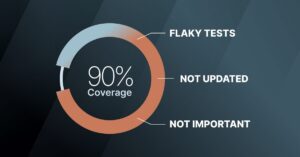


Every organization has growing pains, whether it’s scaling systems, managing budgets, or picking the perfect coffee maker for the new office. Software testing’s chief challenges typically fall into two fundamental categories: technical and organizational.
The challenges engineers tend to home in on are the technical ones. Issues like test degradation, environmental mismatches, and time synchronization errors can cause misleading, inaccurate, or inconsistent test results. These problems are technical at their core, and on a case-by-case basis, they have technical solutions. They occur at all levels of scale.
The other type of challenges are organizational shortcomings that come about as a business scales and starts running 1,000+ Playwright tests. Organizational challenges hamper teams’ ability to manage software tests effectively at scale. These sorts of challenges are easy to overlook until it’s already rampant within an organization. By then, it’s hard to turn the clock back. At that point, you could really use that new coffee maker, too.
That’s why developing a grounded, scalable approach to organizing and coordinating tests is critical for organizations, whether they’re running 100 Playwright tests or 1,000. We’ll examine why this can be so hard, and what teams can do to get it right.
Where test management and organization falls short
Even for test engineers who are great at solving technical problems, organizing Playwright tests in a scalable, consistent way can prove deeply challenging due to issues like the following:
- Limited visibility into test coverage.
- Lack of clear ownership designations over tests.
- Redundant testing by different teams or in different repositories.
- Tests that become outdated as business requirements change, but that remain in place nonetheless.
The root cause of challenges like these is a broken organizational strategy and culture surrounding testing. They emerge when the organization thinks of test automation as something that will “just happen,” and when the organization assumes that its engineers are good enough to work through whichever issues arise during the QA and validation process.
The reality, though, is that even the best QA engineers can’t solve test coordination problems, at least not on their own. They can’t force the organization to ensure that test coverage information is systematically documented instead of being relegated to the realm of “tribal knowledge,” for example. QA engineers also cannot standardize their approach to test ownership and maintenance on their own.
A better approach to test management and coordination
Because these issues are organizational rather than technical in nature, they can’t be solved with traditional engineering tools or methods. The answer is not to try to rewrite test code or merge repositories. These tactics might help on a small scale, but they don’t solve the underlying cultural problems that prevent organizations from managing thousands of tests effectively.
What teams really need to solve these issues is a test orchestration platform. When you manage your tests through a centralized platform, you can enforce ownership rules and authentication policies automatically. You can identify gaps in test coverage by comparing your code base to what’s being tested, and you can track drift and degradation trends over time.
These capabilities enable efficient, scalable test management. For organizations that have hundreds or thousands of tests to run and maintain, they serve as a vital complement to test automation frameworks by filling the orchestration and management gaps that automation code itself doesn’t handle.
How Leapwork Play helps organizations manage Playwright at scale
The organizational gap described above is where Leapwork Play fits. Play adds the enterprise layer around Playwright, allowing teams to keep their existing investment while adding governance, role-based access, approvals, audit trails, reporting, and CI/CD integration.
Playwright executes tests, but enterprise teams also need to know who owns them, who changed them, what they covered, and whether results can support a release decision. Play makes that evidence available through a governed, auditable workflow.
With tests governed and results traceable, teams can address duplicated effort and growing maintenance demands. Reusable components and self-healing automation help limit the burden created by application changes, so teams can apply fixes to shared components rather than repeat them across individual tests.
Playwright remains a powerful foundation for browser automation. For larger test estates that require more than execution, Leapwork Play adds governance, reuse, self-healing, deterministic execution, and a complete audit trail around the framework teams already use.