

Playwright is an incredible testing framework. It is fast, well maintained, and accessible to developers. But this is not enough to prove to risk, compliance, and external auditors that an application and the controls around it are safe. Playwright can do many things, but the framework does not produce a governed record for auditable enterprise test suites that modern businesses demand.
Basic Playwright produces trace artifacts, videos, and screenshots. But Playwright does not provide a governed record of who authored a test, who changed it, what it covers, or whether a failure stopped the release. Nor does Playwright provide evidence mapped to regulatory requirements (e.g. SOC2, ISO) or immutable data for the purpose of meeting these regulatory investigations. In regulated industries, auditors will ask for records that Playwright does not produce by default, and the potential non-compliance fees and fines are impactful for any business.
Playwright is an incredible framework, but it locks out non-engineers by design, including Risk and Compliance staff, and is not designed for enterprises or regulated businesses
Auditors rarely ask to see your tests. They ask five questions about the control around them:
Every mainstream framework reduces to some version of these: SOC 2 change-management and monitoring criteria, ISO/IEC 27001 Annex A controls on change control and logging, computer-system validation expectations in life sciences, and ITGC testing under SOX. None of them mandate a particular test framework, but all of them demand evidence about how that framework is governed.
This is one of the main reasons why we designed Leapwork Play: to democratize access to Playwright for businesses that cannot risk an unhappy user or auditor. Playwright is an incredible framework, but it locks out non-engineers by design, including risk and compliance staff. It’s also not designed for enterprises or regulated businesses without significant investment in building out costly governance arrangements or embedding open-source third-party plugins.
Leapwork solves these enterprise challenges by running native Playwright TypeScript inside a governed platform with enterprise identity, role-based access control, immutable audit logs, and execution traceability from requirement to result, across your entire enterprise application estate.
By default Leapwork includes the critical enterprise features that modern business require:
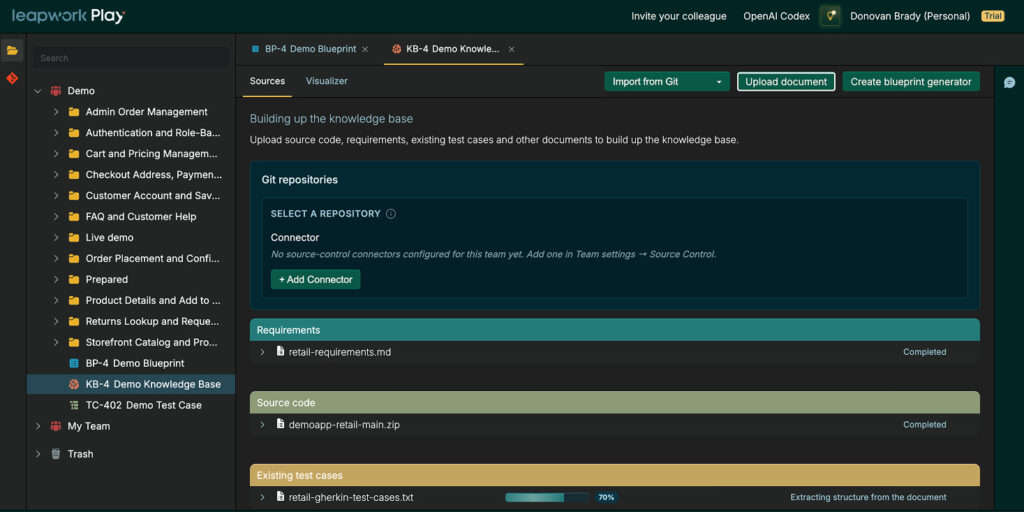
- Identity: SSO integrations, such as Active Directory, so every authored test, edit, and execution is attributable to a named enterprise user.
- Authorization: Role-based access control, so the individual who may author, approve, and execute is a configured control rather than a repository convention.
- Traceability: Audit logs and execution traceability linking a requirement to a test version to the specific run that gated a specific build.
- Residency: Secure, region-based data storage, so regulated data and evidence remain within your selected region.
- Continuity: Self-healing and reauthoring keep coverage live, helping you to avoid the audit finding of a test suite built upon skipped or disabled tests.
Leapwork does not replace Playwright. Leapwork Play enhances Playwright by supplying the identity, security, and governance layer Playwright deliberately leaves out, on top of the native Playwright TypeScript framework that is accessible to engineers to review and edit. In practice, this means Leapwork allows Playwright to operate inside enterprise security and compliance standards rather than alongside them. Leapwork also allows you to move the security practices you already have to a Playwright environment seamlessly. This means existing assets from tools such as Selenium and Cypress can be imported and converted into Playwright rather than rewritten.
Because non-developers author and maintain the same Playwright tests, the people accountable for the control (QA leads, process owners, compliance staff) can produce the evidence themselves instead of requesting a screenshot from an engineer mid-audit.
Leapwork’s own certifications, policies, and security posture are published and continuously available at trust.leapwork.com:
- ISO/IEC 27001:2022 certification (recertified as of August 2026) covering the development, maintenance, and operation of the platform
- A SOC 2 Type II attestation
- Alignment with GDPR and CCPA, underpinned by encryption of data in transit and at rest
- Multi-factor authentication
- Role-based access control
- Regular vulnerability assessment and security testing
Additionally, customer data is never used to train AI models.
Proving an application is safe, and not merely tested, means showing an unbroken chain: an authenticated author, an authorized change, a test mapped to a stated requirement or risk, a retained result tied to a specific build, and a gate that demonstrably stopped release on failure. Leapwork produces that chain as a by-product of normal execution. The cost of discovering the gap during an audit is measured in findings, remediation programs, and delayed releases; Leapwork can help you closing it beforehand.