
Most release-related questions are easy… until someone asks for receipts.
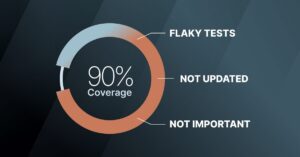
“Did we validate this release?” sounds like a simple yes-or-no question, but enterprise QA teams rarely get away with answering it that way. An auditor wants evidence. A regulator wants a defensible chain of reasoning, while a VP wants an answer before their coffee gets cold. Meanwhile, a green dashboard can show that tests passed, but it cannot necessarily show what those tests verified, which requirements they covered, or whether anything changed along the way.
That is where traceability earns its keep. In our companion piece, “Evidence-Grade Automation: How to Prove to Auditors Your Playwright Tests Ran,” we explored why passing tests alone do not tell the whole story. Here, we follow the evidence trail through Leapwork: from the requirement that starts the process to the test step that implements it, and finally to the record showing exactly what ran and why.
Why traceability is hard to bolt on later
If a test doesn’t capture why it exists at the moment it’s created, no report generated afterward can recover it. Traceability can’t be a document you assemble before an audit; it has to be a property of how tests are made and run.
Leapwork produces it in three connected stages.
| Stage | What Happens | What it Produces |
| 1 – Knowledge base | Requirements, documentation, and existing test assets are ingested as context | A grounded source of truth the system can cite |
| 2 – Grounded generation | Each test, and each step, is generated against that context | A step with an evidence link back to its justification |
| 3 – Deterministic execution | Validated logic runs as fixed steps; changes are recorded, not silent | An auditable record of what ran and what it proved |
Stage one: Requirements and docs become a knowledge base
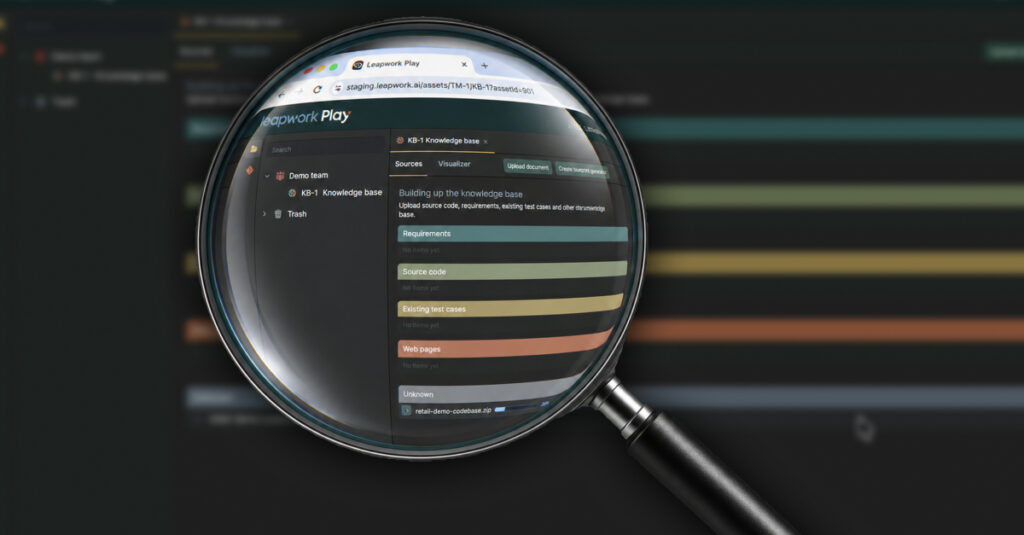
Traceability has to start before generation, because you can’t link a test to a requirement the system has never seen. So, the first step isn’t writing tests; it’s giving the platform something authoritative to reason from.
Leapwork Play builds its tests from your internal documentation and existing application context rather than from a blank prompt. Requirement specs, process documentation, and the test assets you already own become a structured knowledge base. A model working from a bare instruction (“test the checkout”) can only invent what it thinks checkout should do. A model working from your documented requirements is generating against a source it can cite, which is the entire precondition for traceability.
The knowledge base is what turns “the AI wrote a test” into “the AI wrote a test because of this specific requirement.” Grounding first is what makes linking possible later.
Stage two: Every step carries its justification
With that foundation in place, generation changes character. When Leapwork Play or Flow generates a test, the system creates an evidence link at every step of every test case, tracing each generated action back to its source, whether that source is a documented requirement, a recorded application behavior, or an input document.
The distinction worth sitting with is the granularity. A reviewer can open any step and verify that it reflects actual application functionality rather than something the model inferred or invented. Where a passing script used to demand 20 minutes of code archaeology to trust, the justification now travels with the step.
Play also reports back, in plain terms, why each test was generated, what it covers, and where its context came from. That reporting is the same evidence trail viewed from the other end: instead of following one step down to its requirement, you look across a requirement and see exactly which tests and steps stand behind it, and (just as importantly), where coverage is thin.
Stage three: The deterministic boundary keeps the record honest
A link is only trustworthy if what runs is the thing that was linked. This is where Leapwork’s Deterministic by Design architecture does the load-bearing work. AI does its job in the authoring loop, interpreting requirements, drafting steps, generating coverage. But once a test crosses the boundary into execution, the AI has left the building. What runs is a fixed, explicit, inspectable sequence of steps: the same logic, in the same order, every time.
Self-healing shows why this matters most under pressure. When an application changes at runtime, the platform first attempts a pre-recorded deterministic recovery. If AI has to step in, it operates under strict rules. When a repair succeeds, it’s saved as an explicit, reviewable change: a visible decision, not a silent one remade on every subsequent run. A clean stop always beats a wrong action recorded as a pass, because a false “pass” is precisely the kind of untraceable event this whole system exists to prevent.
What it produces when someone asks
Put the three stages together and the abstract idea of traceability becomes a concrete set of questions you can now answer with evidence, not recollection:
- What did this release prove? Coverage mapped to requirements, so “tested” means “these business outcomes were verified,” not “these scripts ran.”
- Why does this test exist? Every step traces to the requirement, recorded behavior, or document that justified it; no code archaeology required.
- What changed, and who decided? Self-healing repairs are logged as explicit, reviewable changes rather than silent drift.
- Can we defend this to an auditor? Audit trails, explainable logic, and access controls are built into how the platform works, so GxP, SOX, and data-sovereignty needs are met as a function of the architecture rather than a binder assembled after the fact.
There’s a practical dividend, too. Because tests execute as fixed, deterministic logic rather than live model calls, the evidence trail costs nothing to keep honest at runtime; there’s no model inference (and no model bill) each time a suite runs. You get the speed of AI where it helps, at authoring, and a durable, auditable record where it counts, at execution. With this in place, the question of “what did this release prove?” stops being an uncomfortable question and becomes one you can answer in a click.