
Product companies often feel most comfortable when they own as much of their technology stack as possible. This sense of ownership creates a sense of control; it gives the company something proprietary to present to their markets, and it makes the architecture easier to explain.
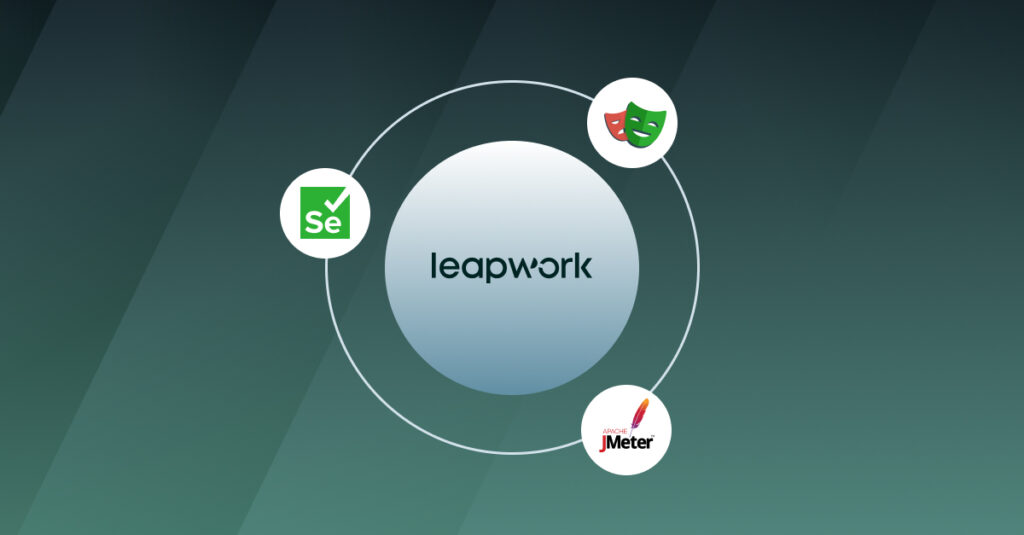
At Leapwork, we built our solutions using Selenium and Playwright as their underlying foundations. These technologies are also available and used throughout the automation community.
This begs a reasonable question: What differentiates Leapwork from these technologies? The answer is that our differentiation lies in what we build around those foundations.
Our differentiation is visible through the processes by which test intent is captured and preserved. It is perceivable in the ways in which assets can be reused. It lies in the rules by which access, execution, evidence, and reporting are governed. It also shows in the people with different levels of technical skill who can participate without taking control away from engineers.
One of the central inspirations for our solutions is the community for which we’ve created them. When we build and evolve our solutions, we directly incorporate the automation community’s experience, learnings, and the ways in which they work into our solutions’ functionality. In other words, we build with the community, not only for them. Read on to see how they actively inspire the work we do.
Incorporating Accumulated Knowledge
Enterprise development and testing teams rarely start with clean architectures; they already have Selenium scripts, Playwright tests, CI pipelines, manual test cases, and people who have spent years understanding how they all work. These teams have already made significant investments in skills, automation assets, and processes.
Those assets also contain a lot of business knowledge. A test may include information about which permissions a user requires, what data needs to exist, which systems must be available, what order the process follows, and what result the business considers correct. In many organisations, this knowledge is not documented anywhere else.
This is why at Leapwork, we believe that progress does not require everything to be replaced.
Selenium and Playwright have already solved important problems. They have strong communities, widely available skills, proven approaches, integrations, examples, and years of learning from real-world usage.
In building our solutions, one of the key ideas we incorporate from these communities is not simply code; it is an understanding of how practitioners work.
These communities show us what people find useful, what they want to retain, which approaches have stood the test of time, and where teams continue to struggle despite having access to a capable framework.
The Importance of Community Learnings and Feedback
Selenium and Playwright are successful community foundations. We benefit from the progress those communities make, and we directly incorporate community input and feedback into our solutions.
At Leapwork, we learn through customer conversations, support cases, partners, community discussions, solution engineers, early adopters, and our own engineering teams. We see similar problems across many customers, partners, support cases, solution engineers, and practitioners. One customer may show us a problem with evidence. Another may have the same underlying problem in a completely different workflow. A practitioner may explain why an apparently obvious product solution would not work in a real enterprise environment.
Over time, all these learnings become part of our solutions. It is not one feature that creates the differentiation; it is the product judgment that accumulates from seeing similar problems repeatedly and understanding which parts should become reusable capabilities.
As we evolve our solutions, we try to look for repeated friction rather than reacting only to the loudest request. Before we decide on new features, we try to understand the actual problems present. This is not always straightforward, as a request that sounds like a test-creation problem may really be about control. A reporting request may actually be about evidence, while a maintenance problem may have started because the original intent of the test was never captured clearly.
We believe the relationship with our communities must work in both directions. That is why Leapwork gives knowledge back through documentation, examples, integration patterns, and practical learning. When a problem belongs in Selenium or Playwright, that should be visible. If the same enterprise problem is being solved independently by many organizations, Leapwork can turn it into a product capability so that every company does not have to build and maintain the same thing again.
Building Beyond the Foundations
Users should be able to understand what comes from Selenium or Playwright, and what Leapwork adds. Being clear about that strengthens our product story because it shows that we are building on technologies practitioners already trust.
In building and evolving our solutions, the Leapwork team starts with what the automation community has already proved. Then, we focus on what happens when automation needs to move beyond one highly skilled person or one engineering team.
As we add the features and functionality enterprises require to use the automation community’s learnings consistently, securely, and at scale, we ask ourselves questions such as these:
- Who is allowed to create or change an automation asset?
- How is it reviewed?
- Can another team understand and reuse it?
- Where is the evidence stored?
- Who can investigate a failure?
- What happens when the original creator leaves?
- How is execution managed across several applications, environments, and teams?
The answers to these questions and the features they inspire form the enterprise layer that Leapwork adds to the foundational technologies on which our solutions are built:
- Leapwork Flow makes complex business-process automation easier to create, understand, maintain, and reuse.
- Leapwork Go builds on familiar performance-testing practices while helping teams manage execution, analysis, and release evidence more consistently.
- Leapwork Play uses Playwright as the modern web-automation foundation and adds the governance, evidence, reuse, and product experience required to make it work across a larger organization.
Leapwork’s differentiation does not come from pretending that we invented a given framework. It comes from how well we make that framework work inside a real enterprise and how quickly we continue learning from the people using it.
Using Selenium and Playwright as a foundation and building evidence-based, feedback-driven, and enterprise-inspired functionality around these technologies has made Leapwork the trust layer for enterprise software delivery. For over a decade, we have supported leading enterprises across industries, regions, and application environments, and we have partnered with enterprises wherever they are based on their teams, applications, and maturity.
Contact our experts today, and we’ll show you how Leapwork can help your organization move fast, build trust, and start driving ROI faster. Book a demo with our team and bring your most complex use cases.